ServicesUnder-sink reverse osmosis
Under-Sink Reverse Osmosis in Duncanville
We install under-sink reverse osmosis for the water you drink and cook with, after a test shows what is in your tap. If the test points to a simpler fix, we tell you. If RO is the right call, we size it to your water pressure and your sink.
How reverse osmosis works and where it fits
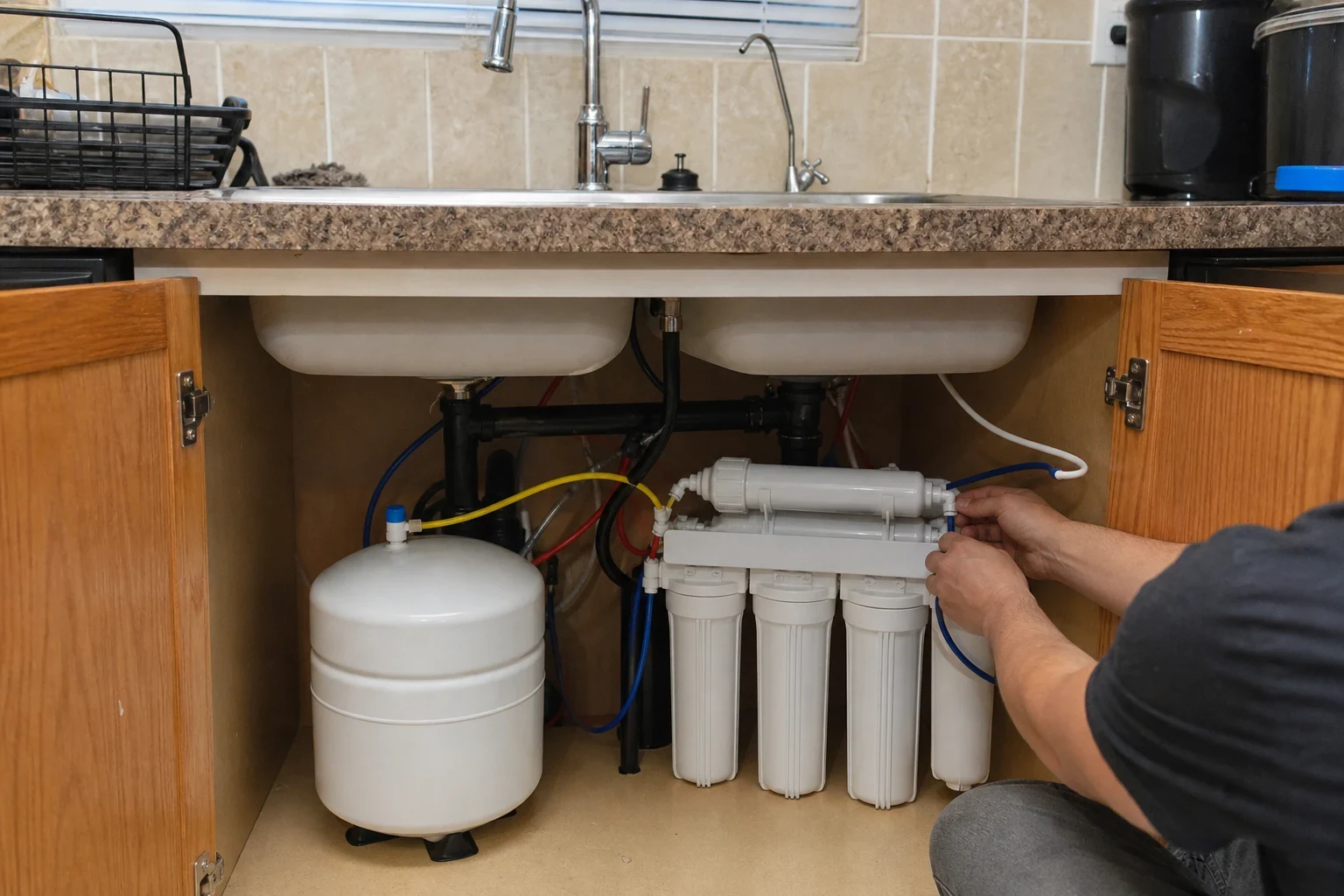
The pressure already in your plumbing does the work. Tap water is pushed against a thin-film composite membrane with openings so fine that water molecules pass and most dissolved solids, metals like lead and many trace compounds stay behind, to be flushed out through a drain line. Two cartridges protect that membrane on the way in: a sediment prefilter that traps grit and a carbon block that pulls out disinfectant. Treated water then collects in a small pressurized tank, and a carbon postfilter cleans up the taste on its way to its own faucet at your sink.
City water in Duncanville is treated and regulated, so RO is rarely about fear. It is a good fit when you want better-tasting drinking water, when older plumbing could be adding lead or copper at the tap, or when you simply want an extra layer for the water your family drinks. It is not the right tool for chlorine smell in the shower or staining on fixtures. Those problems call for whole-house carbon filtration or iron and sediment filtration instead.
That is why we test first. A reading of total dissolved solids, hardness, chlorine and pH tells us whether RO will solve your complaint and how to set it up so the membrane lasts.
What the installation includes
- Pre-install water test
- We check TDS, hardness, chlorine residual and incoming pressure at your kitchen tap. Hardness and chlorine both shorten membrane life, so these numbers decide the prefilter setup.
- Four-stage system
- Sediment prefilter, carbon block, TFC membrane and carbon postfilter. The carbon block matters because chlorine and chloramine degrade TFC membranes over time.
- Feed valve and drain connection
- We tap the cold line with a feed-water adapter and shutoff, and connect the reject line to a drain saddle above the P-trap so wastewater cannot siphon back.
- Dedicated faucet
- Mounted in an existing sprayer or soap hole when one is free. If your countertop needs a new hole, we explain the options for your surface before drilling anything.
- Tank, shutoff and check valve
- The automatic shutoff stops flow to drain when the tank is full, and the check valve keeps tank pressure from pushing back through the membrane.
- Startup and cleanup
- We flush the new filters, drain the first tank, check every fitting for drips and leave the cabinet the way we found it.
Signs an RO system may be worth it
You buy bottled water out of habit
If the tap tastes flat or chemical and the family has quietly switched to jugs, RO usually closes that gap for drinking and cooking.
Your home has older copper plumbing
Lead solder was common in copper joints before the late 1980s. A first-draw test shows whether anything is reaching the tap, and RO is one of the few point-of-use systems that reduces dissolved lead.
Ice and coffee taste off
Dissolved minerals and residual disinfectant show up first in coffee, tea and ice cubes. RO plus a carbon postfilter takes most of that out.
A pitcher filter is not keeping up
Pitcher cartridges are small and slow. If you are refilling one several times a day, a tank under the sink is the practical next step.
An old RO unit runs nonstop
Constant trickling to the drain usually means a failed shutoff valve or a spent membrane. We check the parts before recommending a new system.
What affects the price
We give you a written, line-item estimate after the water test, so you know the parts and labor before we start. The price depends on what your water and your sink cabinet need, not on a fixed package.
Number of stages
A standard four-stage unit covers most homes. Add-ons like a remineralization cartridge or an extra carbon stage add parts and later replacement costs.
Water pressure
Membranes need steady pressure to produce well. If your incoming pressure tests low, a booster pump or permeate pump may be needed.
Faucet and countertop
Using an existing hole is simplest. Drilling stone or quartz takes different tooling and more time than laminate.
Pretreatment
Hard water scales a membrane fast. If the hardness test is high, protecting the membrane may change the overall plan.
Extra connections
Running a line to a refrigerator ice maker or water dispenser adds tubing, fittings and labor.
How the job runs
- 1
Phone call and test
We talk through what is bothering you, then test the water at your kitchen tap. You see the readings and hear what they mean before any recommendation.
- 2
Honest recommendation
If RO fits, we explain which configuration and why. If your water would do better with a softener ahead of it, or the issue is really a whole-house one, we say so and give you a written estimate either way.
- 3
Installation
Most installs take a couple of hours in the sink cabinet. We shut off the cold supply, mount the filter housings and tank, run the lines and set the faucet.
- 4
Flush and verify
We flush the carbon fines out, drain the first full tank and take a TDS reading at the new faucet so you can compare it with what came out of the tap before.
Reverse osmosis questions we hear most
Does RO send water down the drain?
Yes, some, by design. The membrane needs a steady flow of reject water to carry away what it blocks, and that flow goes to the drain. The amount depends on your water pressure and the system's design. A permeate pump can reduce it, and we can tell you if one suits your setup.
Does RO take out good minerals too?
Yes, the membrane removes most dissolved minerals, including calcium and magnesium. Most people get far more of those from food than from tap water. If you miss the fuller taste, a remineralization cartridge after the membrane adds a little back.
How often are the filters replaced?
The prefilters and postfilter are typically changed on a set schedule, and the membrane outlasts the cartridges. Exact timing depends on your water and usage. Our filter replacement and maintenance service tracks it so the membrane never runs on worn-out prefilters.
Will it fit under a sink with a garbage disposal?
In most cases, yes. The tank can usually go off to the side or in the cabinet next door. We check the space at the visit and explain the layout before installing.
Will RO get rid of chlorine smell in the shower?
No. An under-sink system treats only the water from its own faucet. For odor throughout the house, whole-house carbon filtration is the right choice, and some homes have both.
Find out if RO fits your water
We will test your tap, show you the numbers and tell you plainly whether reverse osmosis is the right fix. We serve Duncanville and nearby towns including DeSoto, Cedar Hill and Lancaster.